
When people look for contemporary Jewish art, they often want more than a recognizable subject. They want a work that can carry memory, devotion, and modern visual energy at the same time. Abstract Jerusalem paintings do exactly that. They do not flatten the city into a single view; they let Jerusalem appear as atmosphere, direction, and inner light. That is what makes this body of work so compelling for readers who care about Jewish heritage and also want art that speaks fluently in a contemporary home.
In Alex Levin’s Jerusalem paintings, abstraction becomes a way to hold several layers together. The city can feel ancient and immediate, earthly and elevated, architectural and spiritual. Light is never just decoration. It becomes the structure that connects prayer, memory, sacred places, and the viewer’s own sense of place. If you are trying to understand why these works resonate so strongly within contemporary Jewish art, the answer lies in how they translate meaning into composition.
Explore Abstract Jerusalem Paintings - Modern and Contemporary Jewish Art by Alex Levin at ArtLevin.com.
Light as the first signal
The strongest abstract Jerusalem paintings begin with light because light is the clearest visual shortcut to spiritual atmosphere. In works such as Golden Essence of Jerusalem, The Golden Light of Jerusalem, and Golden Aura of Jerusalem, the color field itself does a great deal of the interpretive work. Gold does not simply suggest beauty or richness; it creates a sense of radiance that feels associated with holiness, uplift, and reverence. In these compositions, the viewer is not asked to decipher a literal scene first. Instead, the eye is drawn into a luminous zone that feels both emotional and symbolic.
That approach matters in contemporary Jewish art because it allows sacred meaning to remain present without depending on direct illustration. A viewer can feel the city before naming it. The painting then becomes less like a record of a place and more like an encounter with its mood. This is one reason these works can live comfortably in modern interiors: they are visually decisive, but they do not rely on heavy narrative explanation. The symbolism is carried by the handling of color, contrast, and glow.
Prayer built into the composition
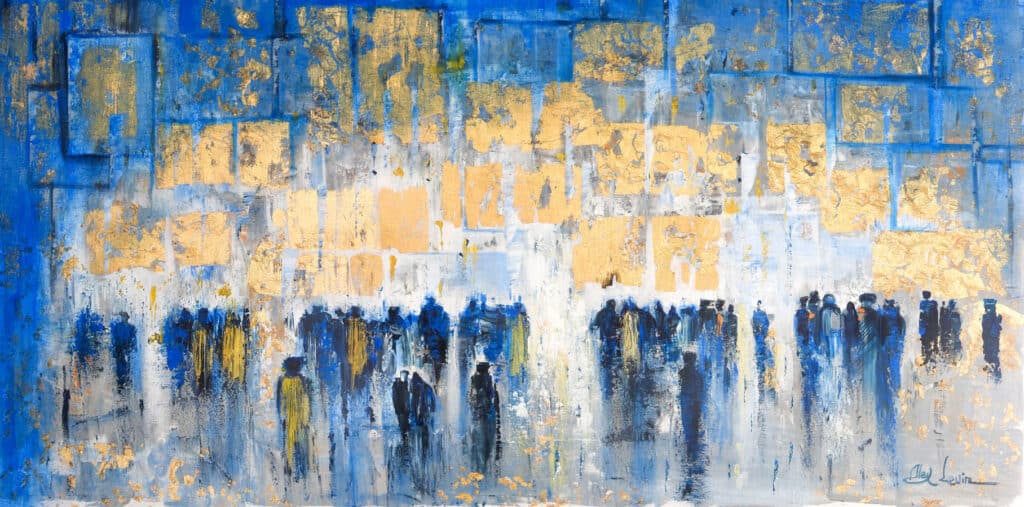
Several paintings in the collection make prayer visible not by showing a single worshipper, but by building repetition, movement, and vertical energy into the image. Light from the Kotel, Light of Faith at the Western Wall, The Prayerful Light of Jerusalem, and Jerusalem - The Golden Stream of Prayers each suggest that prayer is not an isolated event. It is a current. It moves through the painting in a way that feels collective rather than private, which suits the communal meaning of the Kotel.
What is useful for the viewer here is to notice how the compositions often guide the eye upward or inward. That directional pull matters. It gives the painting a sense of spiritual ascent without resorting to a literal staircase of symbols. The Western Wall itself becomes more than a location; it becomes a visual center where the work gathers its energy. In a contemporary Jewish art context, this is a powerful strategy because it links a familiar sacred place to an abstract language that can still feel fresh and immediate.
Jerusalem between earth and heaven
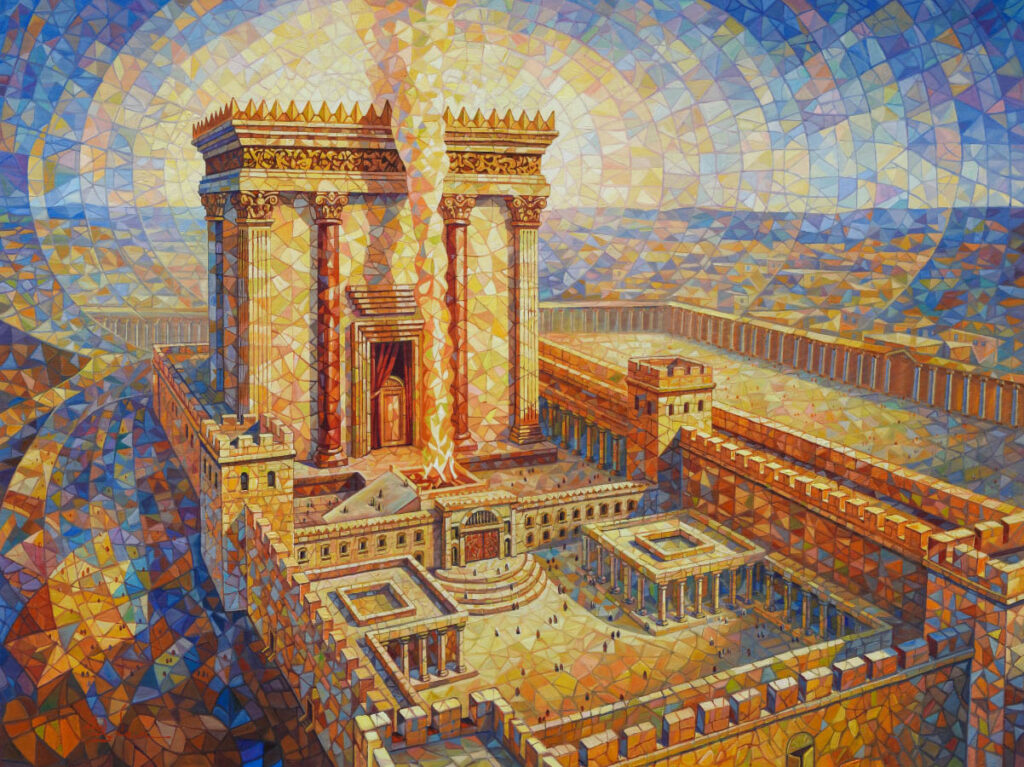
One of the most interesting qualities in these abstract Jerusalem works is the way they hold two registers at once. On one level, the city is clearly tied to stone, gates, walls, and streets. On another, the paintings open toward something beyond the visible world. Roots of Light The Second Temple, The Light of the Temple in Jerusalem, and The Radiance of Jerusalem’s Ancient Walls suggest this dual register through their titles and through the visual tension between grounded forms and radiant atmosphere.
This balance between earthly structure and heavenly suggestion is central to the appeal of contemporary Jewish art that deals with Jerusalem. The city is not presented as fixed or finished. It is imagined as a place of approach, ascent, and longing. Warm tones can suggest Temple imagery and sacred intensity, while cooler passages can steady the composition and bring in a more modern, reflective mood. The result is a painting that does not force one meaning over another. It lets the viewer experience Jerusalem as layered and alive, with holiness emerging through form rather than replacing it.
Generations, continuity, and living inheritance
Jerusalem in this collection is never only a city of place. It is also a city of memory and transmission. Works such as The Path of the Jews Through the Ages, The Continuity of Israel’s Generations, Jewish Generation, and The Torah That Binds Us Together expand the conversation beyond architecture and into inheritance. These paintings are especially valuable for viewers who want contemporary Jewish art that can hold identity in a broader sense, not just one sacred site.
The visual language here often feels more processional than static. That is important. It suggests that Jewish continuity is not a frozen idea but a living passage. The titles reinforce that sense of movement across time, but the paintings themselves also need to do the work through rhythm, balance, and symbolic layering. When a collection includes both Jerusalem imagery and Torah-centered or generational themes, it reminds us that Jewish art can speak about continuity without becoming repetitive. It can connect sacred history to present-day visual experience in a single composition.
Selected artworks to consider
Abstract Jerusalem Painting: Light from the Kotel
Light from the Kotel is one of the clearest examples of how this collection centers the Wall as a source of visual and spiritual radiance. It is a strong anchor work if you want the Kotel to remain the emotional center of a room.
Abstract Jerusalem Painting: Roots of Light The Second Temple
Roots of Light The Second Temple brings Temple imagery into an abstract language of ascent and illumination, making it especially useful for readers drawn to sacred symbolism that feels both ancient and contemporary.
Abstract Jerusalem Painting: Golden Essence of Jerusalem
Golden Essence of Jerusalem uses gold to create an immediate sense of brilliance and sacred presence, making it a good example of how color can carry reverence without literal depiction.

Abstract Jerusalem Painting: The Path of the Jews Through the Ages
The Path of the Jews Through the Ages expands the Jerusalem theme into historical continuity, which gives the collection a broader narrative frame beyond one location.

Abstract Jerusalem Painting: The Light of the Temple in Jerusalem
The Light of the Temple in Jerusalem emphasizes Temple-centered radiance and helps connect the collection’s abstract forms to one of the deepest strands of Jewish longing and memory.
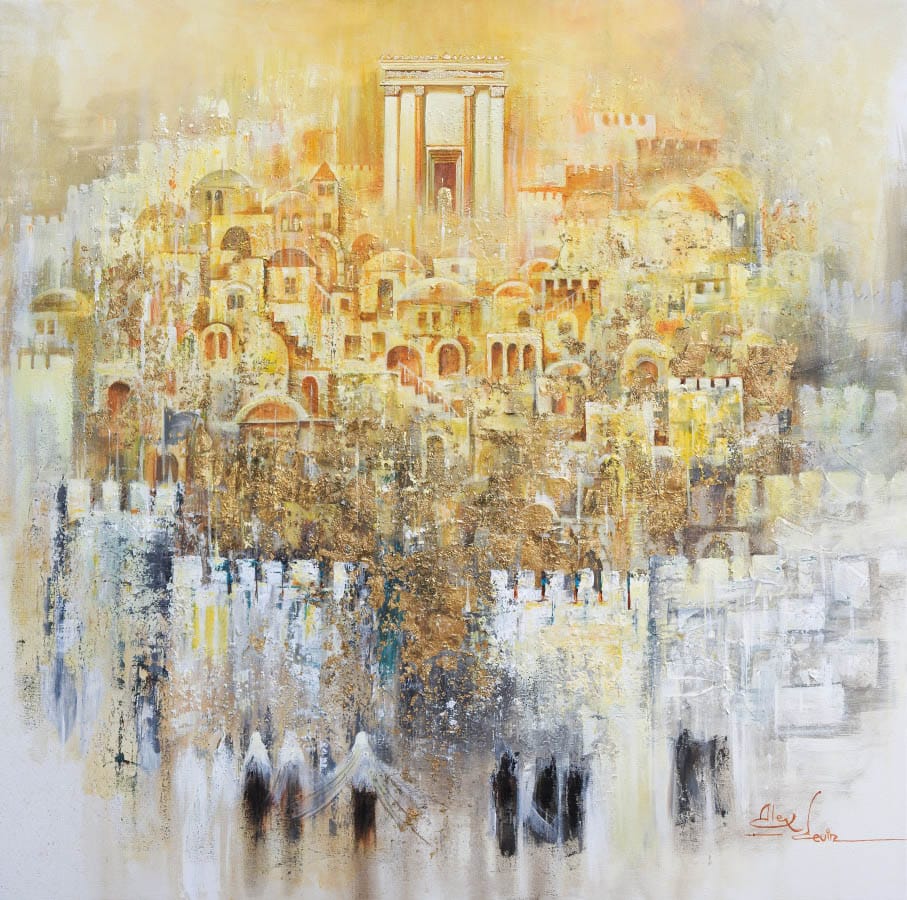
If you are drawn to contemporary Jewish art, these abstract Jerusalem paintings offer a clear lesson in how modern form can deepen rather than dilute tradition. They show that symbolism does not have to be heavy-handed to be meaningful. Through light, color, and compositional motion, the paintings turn Jerusalem into a lived spiritual presence. That is their real strength: they invite you to read the city not only as a place, but as an ongoing expression of prayer, continuity, and hope.
For readers, the practical benefit is simple. Once you begin to notice how each painting handles light, sacred centers, and visual movement, it becomes much easier to choose a work that matches your own sense of Jewish heritage and the kind of atmosphere you want in a room. In that way, the collection is not only about Jerusalem as subject. It is about how art can keep Jerusalem present in daily life.


No comments:
Post a Comment